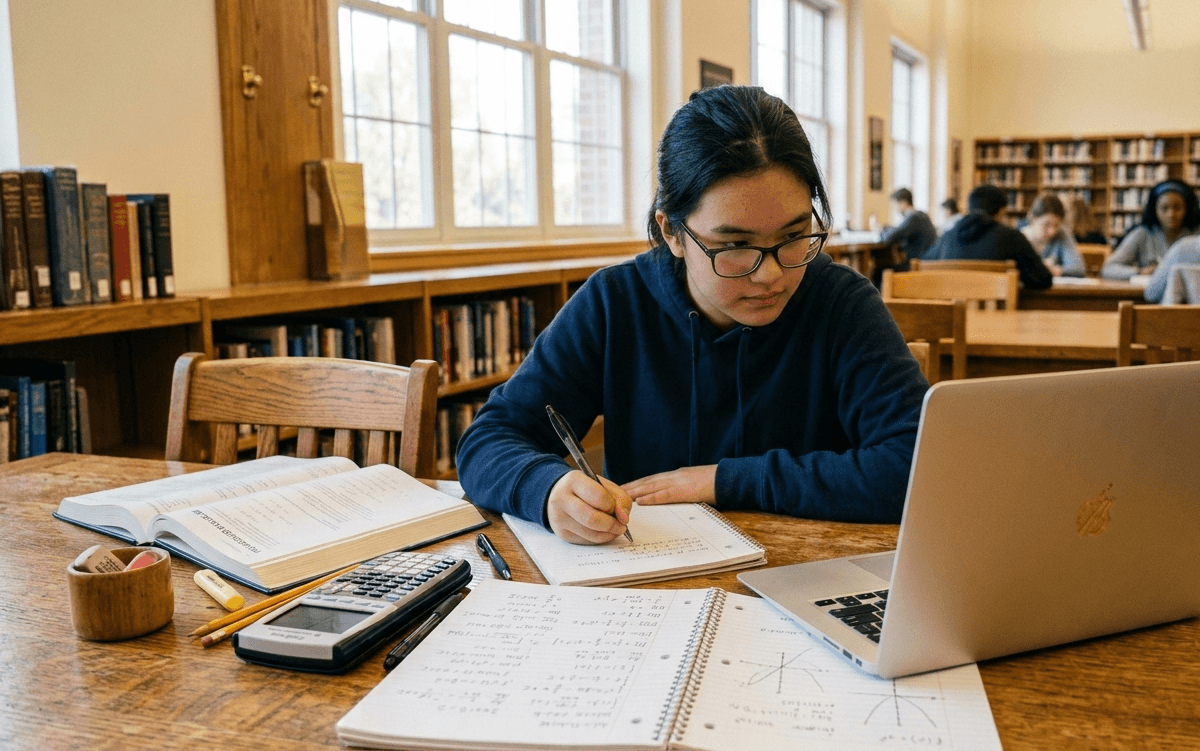

Tutoring in Burnaby: A PhD-Led Guide for Parents Choosing In-Person or Online Support
When "It's Just Not Clicking" Means Something Real
If you're a parent in Burnaby searching for tutoring, chances are it started with a small signal. A test that came home lower than expected. A kid who used to like math and now avoids it. That quiet sentence at the dinner table: "I just don't get it."
Here's the truth we've learned from years of PhD-led practice: struggle is almost never about a lack of ability. It's about concept gaps that compound. A student who never fully understood how fractions work will hit a wall in algebra. A Chem 11 student who memorised — but didn't understand — the mole concept will drown in stoichiometry. The grade is the symptom. The gap is the cause.
That distinction changes everything about how you choose tutoring in Burnaby. The goal isn't more drilling. It's finding the exact spot where understanding broke down, and rebuilding from there — so the next concept doesn't become a fresh panic.
This guide walks you through how to tell when your child needs support, how in-person and online tutoring actually differ in practice, and what a genuinely effective session looks like — with real examples from the BC curriculum along the way.
Not sure where the gap actually is? Book a free assessment — no pressure, just clarity.
How to Tell the Difference Between a Bad Week and a Real Gap
Every student has an off week. What you're watching for is a pattern. A single low mark on a hard unit test isn't cause for alarm. A slow slide across a whole term — where each new topic feels harder than the last — usually is.
Here are the signals parents in Burnaby most often describe to us:
- "It's not clicking anymore." Homework that used to take 20 minutes now takes an hour of frustration.
- Avoidance. Your child suddenly "has no homework" in one specific subject, or leaves it until it's too late to ask.
- Memorising instead of understanding. They can recite a formula but can't tell you when to use it.
- "The fog before the exam." They study, but everything blurs the moment the test starts.
- A confidence drop. "I'm just not a math person" — a phrase that's almost always false, and always worth challenging.
The last one matters most. Confidence and competence feed each other. When a student believes they can't do something, they stop trying — which guarantees they won't improve, which confirms the belief. Good tutoring breaks that loop by giving them a genuine win they can feel.
If you're weighing whether it's time to bring in help, our post on does my child need a tutor walks through the decision in more detail.
Why the "Why" Beats Memorisation Every Time
Most tutoring drills the symptom. A student is failing quadratics, so they get a worksheet of 40 quadratics. Sometimes that helps. Often it just teaches them to fake competence for one test — and the gap resurfaces later, bigger.
We teach for understanding first, and it shows fastest in science. Take a classic Chem 11 stoichiometry problem. A memoriser tries to recall a procedure. A student who understands sees the whole relationship:
moles = (mass in grams) / (molar mass in g·mol⁻¹)
Once that clicks, a question like "how many grams of CO₂ form when 12 g of carbon burns completely?" stops being a memory test. Carbon's molar mass is about 12 g·mol⁻¹, so 12 g is 1 mole of C. The balanced reaction C + O₂ → CO₂ tells you 1 mole of carbon makes 1 mole of CO₂, and CO₂'s molar mass is about 44 g·mol⁻¹:
mass CO₂ = 1 mol × 44 g·mol⁻¹ = 44 g
No formula was memorised in isolation — the ratio came from understanding the balanced equation. That's the difference. The next stoichiometry problem, with different numbers, is now solvable instead of terrifying.
The same principle runs through physics. Students often panic at kinematics because they try to memorise five equations. But if they understand that motion links displacement, velocity, acceleration and time, one equation covers a huge range of problems:
Δx = v₀t + ½at²
Understand what each symbol means — starting velocity, acceleration, time elapsed — and you can reason your way through a problem instead of guessing which formula to grab. That's what we mean by fixing the foundation.
You can read more about this in concept gaps vs practice gaps, which explains why cramming reliably fails.
Want to know exactly which concept broke down for your child? A free assessment pinpoints the real gap — so tutoring targets the cause, not just the grade.
In-Person Tutoring in Burnaby: When Being in the Room Wins
There's something powerful about sitting beside a patient tutor with a shared piece of paper between you. In-person tutoring in Burnaby has real, specific advantages, and for some students it's clearly the better fit.
In-person tends to shine when:
- Your child is younger (K–7), where hands-on, side-by-side attention keeps them focused and engaged.
- They get distracted easily and benefit from the accountability of a set place and time.
- The subject is highly visual or physical — drawing free-body diagrams in physics, sketching organic chemistry mechanisms, or working through geometry proofs where you're both pointing at the same figure.
- Your child simply connects better with a person in the room than a screen.
For Burnaby families, in-person also removes a subtle friction: there's no "I'll do it later" once the session is booked and the tutor is there. It's a commitment the whole household can see.
Our in-person Burnaby tutoring options cover elementary foundational skills right through to Grade 12 subject support and college-level help.
Online Tutoring Across Metro Vancouver: More Flexible Than You'd Think
A few years ago, many parents assumed online tutoring was a watered-down version of the real thing. That's no longer true — and for a lot of students, online is genuinely the better option.
Online tutoring tends to work best when:
- Your family's schedule is packed — no drive time means a session can fit into a weeknight that in-person never could.
- You live across Metro Vancouver — Vancouver, New Westminster, Coquitlam, Richmond, Surrey, or North Vancouver — and want PhD-led quality without geography being the deciding factor.
- Your child is a teen or university student who's comfortable with screens and works well independently between sessions.
- The subject is well-suited to a shared digital whiteboard — algebra, calculus, and exam prep all translate beautifully online.
Modern online sessions use interactive whiteboards where tutor and student write on the same space in real time, screen-share the actual coursework, and save every worked example for later review. A UBC calculus student can share the exact problem set they're stuck on; a SAT student can work timed sections with immediate feedback.
If you're torn between the two, choosing in-person vs online breaks the decision down by age, subject, and learning style.
What a Genuinely Effective Session Actually Looks Like
Whichever format you choose, the method is what determines results. Here's what a strong tutoring session looks like in practice — and what to look for when you evaluate any tutor in Burnaby.
It starts with a diagnosis, not a worksheet. Before drilling anything, a good tutor finds where understanding broke down. A Grade 10 student failing quadratics might actually have a gap in factoring — or even in basic negative-number arithmetic from years earlier. Treating the visible topic without finding the root gap wastes everyone's time.
It teaches the "why" before the "how." Every step is explained so the student can reconstruct it themselves later. If they can only do the problem when you're watching, nothing has actually been learned.
It builds in real coursework. We work with your child's actual textbook, assignments, and upcoming tests — not a generic parallel curriculum. Progress you can see on the next quiz is progress that motivates.
It develops exam strategy and study routines. Understanding the material is half the battle; performing under time pressure is the other half. That's especially true for BC Provincial assessments, AP, IB, and the SAT.
This is where being a PhD-led practice matters. Dr. Shreyank Gupta (Ph.D.) sets the method and the quality bar, and a team of qualified tutors delivers it across the full range of math and science subjects. (The PhD leads and oversees the practice — he isn't necessarily the tutor for every subject or session.) The combination — genuine rigour, an understanding-first method, and one place that covers everything from K–7 reading to UBC-level orgo — is hard to find locally.
Matching the Subject to the Right Support
Different subjects have different failure points, and knowing them helps you ask the right questions.
Math (elementary → university). Gaps here are cumulative and sneaky. A shaky Grade 7 foundation quietly sabotages Pre-Calculus 12. This is where diagnosis matters most — the visible struggle is rarely the true source.
Sciences (Physics 11/12, Chemistry 11/12, Biology). Students often try to survive by memorisation, and it fails hardest exactly where they lean on it most. Biology is a classic example — genetics looks like memorising, until you realise it's really about ratios. A monohybrid cross of two heterozygous parents (Aa × Aa) gives a predictable pattern:
3 : 1 phenotypic ratio (dominant : recessive)
Once a student understands the Punnett square logic, they can predict any cross instead of memorising outcomes. That's the shift we aim for in every science subject.
Organic Chemistry. "Orgo" terrifies students because it looks like endless memorisation of reactions. It isn't — it's pattern recognition built on electron behaviour. Understand the mechanism and the reactions follow. This is true at both the high school and university level (including UBC and SFU courses), and it's one of our core specialities. See our organic chemistry tutoring page for more.
Exam prep (Provincials, AP, IB, SAT). Here, content mastery meets strategy. Knowing the material isn't enough if the test format ambushes you. Structured, focused prep turns "the fog before the exam" into a plan.
Your Next Step: A Free, No-Pressure Assessment
Choosing tutoring in Burnaby doesn't have to be a leap of faith. The single most useful thing you can do is find out exactly where your child's understanding stands — and that costs nothing.
We offer a free assessment designed to pinpoint the real concept gap behind the grade. There's no obligation and no pressure. You'll leave with genuine insight into what's going on, whether or not you choose to work with us.
From there, we'll recommend the format that actually fits your child — in-person here in Burnaby, or online across Metro Vancouver — and match them with a tutor who teaches for understanding, not memorisation.
Ready to turn frustration into confidence? Book your free assessment at drshreyankeducare.com/book, or simply call or text us at 672-855-8577. You can also reach out through our contact page — whatever's easiest. In-person in Burnaby or online across Metro Vancouver, we're here to help the "why" finally click.
Frequently Asked Questions
How much does tutoring in Burnaby cost?
Costs vary by subject, level, and whether sessions are in-person or online. The best first step is a free, no-obligation assessment — it identifies exactly what your child needs so any plan is built around real gaps, not guesswork. Book yours at drshreyankeducare.com/book or call 672-855-8577.
Is online tutoring as effective as in-person for my child?
For many students, yes — and sometimes it's better. Online works especially well for teens and university students, busy schedules, and screen-friendly subjects like algebra, calculus, and SAT prep. In-person often suits younger children and highly visual work. A free assessment helps us recommend the right fit for your child specifically.
What subjects do you cover?
Math from elementary through university (including Pre-Calculus 12, Calculus 12, and AP/IB), sciences (Physics 11/12, Chemistry 11/12, Biology), Organic Chemistry at high school and university level, SAT prep, and BC Provincial and other exam preparation — all delivered through our PhD-led, understanding-first method.
Can you guarantee my child's grades will improve?
No honest tutor can guarantee a specific grade, and we won't pretend otherwise. What we can do is diagnose the concept gaps behind the struggle and teach for genuine understanding — the foundation that real, lasting improvement is built on. Confidence and comprehension come first; better grades tend to follow.
Need one-on-one help with this? Our tutors can guide you step by step.
Explore Our Tutoring Programs