
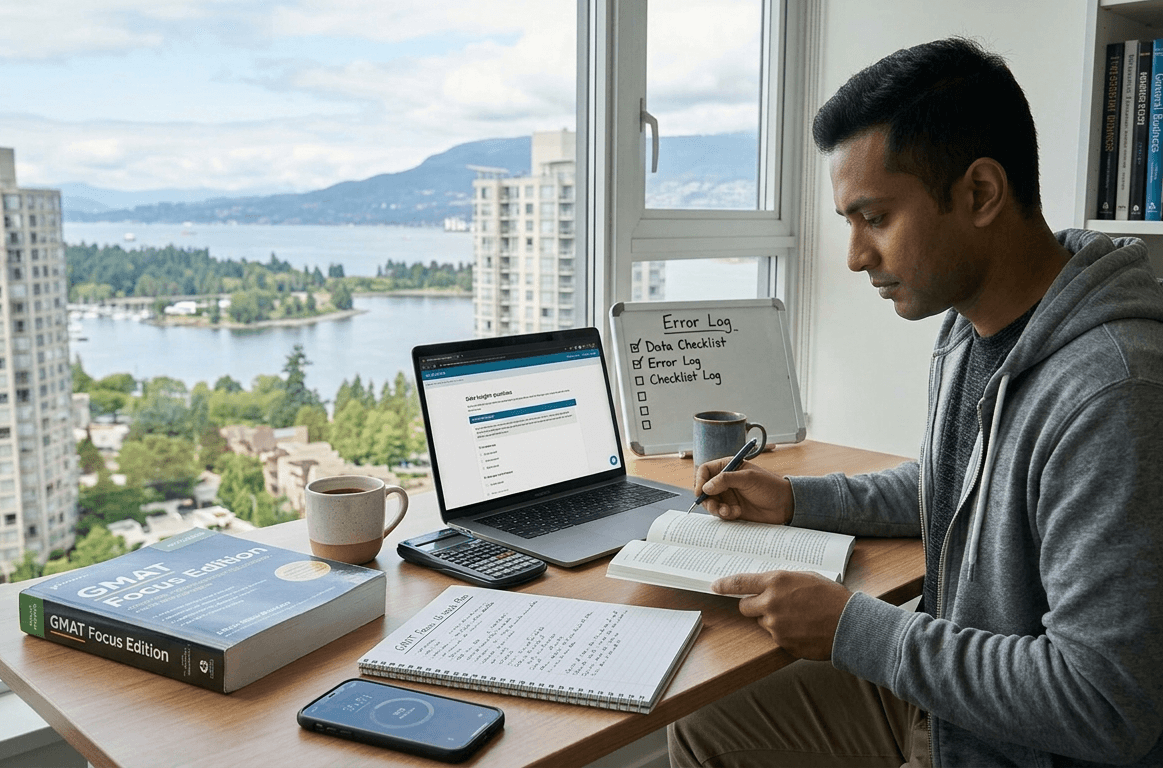
GMAT Prep Vancouver & Burnaby: 12-Week Focus Edition Guide
Most applicants in Metro Vancouver should prepare for the GMAT Focus Edition over 8–12 weeks. Start with a full-length timed diagnostic, build an error log, study one section at a time, add timed practice from the middle of the plan and finish with two full mock tests taken under exam conditions. Work with a GMAT tutor in Burnaby or online if your score has plateaued, you are retaking or you need a plan fitted to a fixed application deadline.
In short:
- Format: three sections (Quantitative, Verbal, Data Insights), 45 minutes each, 64 questions in total.
- Score: 205–805 overall, 60–90 per section.
- Timeline: about 12 weeks at roughly 8–10 focused hours per week.
- Method: diagnose, fix concept gaps, train pace, review every mock properly.
- Support: private coaching, small groups, in person in Burnaby or online across Metro Vancouver.
Most MBA applicants start by buying a question bank, doing a few hundred problems and hoping the score climbs. On the Focus Edition that approach stalls quickly. The exam is shorter and tighter than the old GMAT, it rewards accuracy under time pressure and it tests business-style reasoning rather than textbook content. A score is rarely lost because you "don't know the material". It is lost on pacing, careless errors and a handful of question types you never trained properly.
What Is the GMAT Focus Edition and How Is It Structured?
The GMAT Focus Edition is the current version of the Graduate Management Admission Test, used for MBA and other business-school admissions. Since November 2023 it has been the only version offered. If you find an article describing four sections, an essay and a 200–800 scale, it is out of date.
Here is the structure at a glance:
- Three sections: Quantitative Reasoning, Verbal Reasoning and Data Insights.
- 64 questions in total: 21 Quantitative, 23 Verbal and 20 Data Insights.
- Time: 45 minutes per section, 2 hours 15 minutes overall.
- Removed content: the Analytical Writing essay, Sentence Correction and Geometry.
- Review and edit: you can bookmark questions and change up to three answers per section.
- Section order: you choose the order in which you take the three sections.
Two practical consequences follow. First, because you can choose your section order and review answers, strategy now matters as much as skill. Deciding which section to take first, when to bookmark a question and when to move on are all trainable. Second, the Data Insights section brings Data Sufficiency together with graphs, tables and multi-source reasoning. It is unlike anything in a school or university exam, so it needs dedicated practice rather than general math revision.
How Is the GMAT Focus Edition Scored and What Are the Retake Rules?
The GMAT Focus Edition reports a total score from 205 to 805, always ending in a 5, made up of three equally weighted sections. Each section also receives its own score between 60 and 90. Because the scale changed, Focus Edition scores cannot be compared directly with scores from the old GMAT. Ignore any forum post quoting a 700+ on the old scale when setting your target.
The rules that matter for planning:
- Attempts: up to 5 in a rolling 12 months and 8 in a lifetime.
- Score validity: 5 years.
- Fee: about $275 USD at a test centre and about $300 USD online, with taxes and exchange rates affecting what you actually pay.
Fees, policies and availability can change, so confirm the details on the official GMAT website (mba.com) before you book.
What GMAT Score Do You Need for an MBA in Vancouver and Burnaby?
The honest answer is that it depends on the school and on the rest of your application. Published guidance often gives a floor, not a target. SFU's Beedie School of Business, for example, lists recommended test scores of 550 on the classic GMAT, 515 on the GMAT Focus Edition or 155 per section on the GRE for its full-time MBA. Those are recommended minimums. Competitive applicants, scholarship candidates and people targeting more selective programs usually aim well above them.
A sensible way to set your target:
- Shortlist 3–5 programs and read each school's class profile and score guidance on its own website.
- Aim above the posted figure, not at it, especially if your GPA or work history has gaps to offset.
- Use Focus Edition numbers only, never converted forum figures.
- Work backwards from application deadlines to a test date that leaves room for one retake.
- Treat the score as one part of the file. Work experience, essays, references and interviews all carry weight but a strong score keeps options open and can support scholarship applications.
Our own coaching targets a 675–750+ Focus Edition range for applicants aiming at highly competitive programs, with the plan tailored to the school list you actually have.
How Long Should You Prepare for the GMAT Focus Edition?
Plan for 8–12 weeks. Twelve weeks is a comfortable window for a working professional studying part-time, at roughly 8–10 focused hours a week. Intensive plans can compress the same structure into fewer weeks when a deadline is close and applicants starting far below their target or returning to math after a long gap, often benefit from the full 12 weeks or more.
The right length depends on four things: your diagnostic score, your target score, your weekly study time and the gap between your test date and your application deadlines. Decide the test date after you have a plan, not before.
What Does a 12-Week GMAT Study Plan Look Like?
A good 12-week plan moves from diagnosis to foundations, then to timed practice, full mocks and a calm final week. Each phase has a different job.
Week 1: Take a Diagnostic and Build Your Error Log
Sit one full-length, timed Focus Edition practice test before you study anything. The point is not the score. It is the pattern: which section is weakest, where you ran out of time, and whether your errors are conceptual, procedural or careless. Build an error log from this test. You will use it for the next 11 weeks.
Weeks 2–5: Build Foundations One Section at a Time
Work through content one section at a time, with short untimed sets so you can learn the method before you learn the speed.
- Quantitative: arithmetic and number properties, percentages and ratios, algebra and equations, rates and work, statistics and counting.
- Verbal: critical reasoning (assumptions, strengthen and weaken, evaluate) and reading comprehension (structure, inference, main idea).
- Data Insights: data sufficiency logic, table analysis, graph interpretation, two-part analysis and multi-source reasoning.
End each week with a 20–30 question mixed set and add every miss to the error log with a reason, not just the right answer.
Weeks 6–9: Add Timed Practice and Pacing
Now add the clock. Do timed sets of 7–10 questions, then full 45-minute sections. Practise the skills that only exist on the Focus Edition: bookmarking a question you are unsure about, using the three-answer review wisely, and abandoning a time-sink early. Check your error log weekly. If the same error type appears three times, stop doing mixed sets and drill that topic until it stops appearing.
Weeks 10–11: Take Full Mocks Under Exam Conditions
Take two full-length practice tests, one per week, at the same time of day as your real appointment. Rehearse your section order, your breaks and your note-taking routine. Spend more time reviewing each mock than taking it.
Week 12: Taper and Prepare for Test Day
No new material. Review your error log, redo a handful of past misses, and do light timed sets to stay sharp. Sort your logistics: ID, travel or room set-up, and an early night. A calm test day is the result of a boring final week.
How Do You Prepare for GMAT Quantitative Reasoning Without Geometry?
With geometry removed, GMAT Quant is mostly arithmetic, algebra and word problems, and the way to prepare is to build speed and judgement on a small set of topics rather than to cover everything. That sounds easier but many applicants have not done structured math in years, and the GMAT rewards fluency over brute-force calculation. The recurring problems are algebra done slowly, percentage and ratio setups that go wrong, and rate and work problems solved by guesswork instead of a clean framework.
Strategies that work:
- Set up before you calculate. Spend the first 20 seconds deciding what the question is really asking.
- Estimate and test answer choices when the numbers are awkward.
- Know your number properties cold. Odd and even, divisibility, remainders and factors save minutes.
- Do not chase one hard problem. Make a strategic guess and protect the next five questions.
- Write cleanly. Most careless errors come from messy working, not missing knowledge.
What Should a GMAT Quant Tutor in Vancouver Actually Do?
A good GMAT quant tutor finds the specific concept gap that is costing you points and rebuilds it, rather than re-teaching every formula. This is the section where tutoring tends to produce the fastest change because quant errors are usually traceable to one or two habits.
Look for a tutor who will:
- Diagnose before teaching, using a full-length mock and your error patterns.
- Explain why a method works, so you can adapt it to a question you have never seen.
- Train pace as well as accuracy, with timed sets and clear per-question time targets.
- Teach strategic guessing, so you know when to leave a question and move on.
- Show your progress with evidence, not reassurance.
If a tutor's plan is simply "do more questions", you are paying for a question bank with a person attached.
How Do You Improve GMAT Verbal Reasoning Without Sentence Correction?
With Sentence Correction gone, Verbal is critical reasoning and reading comprehension and both reward the same skill: understanding how an argument or passage is built. Practise identifying the conclusion, the evidence and the unstated assumption before you look at the answer choices. For passages, summarise each paragraph in a few words as you read, so the structure is in your head when the questions arrive.
Speed-reading does not help here. Disciplined reading does. If you are an English-language learner or have been away from academic reading, daily practice with long-form business and science writing builds the stamina this section needs.
How Do You Master GMAT Data Insights Questions?
Data Insights asks you to combine information from tables, graphs and short texts, then make decisions with it. It is closest to real business analysis and it is the section where applicants lose the most time and the one most under-trained.
The strategy is simple but must be practised:
- Read the question first, then extract only the data you need.
- Be strict about time per question. A single multi-source set can eat five minutes if you let it.
- Learn data sufficiency logic properly, because it now lives here and is a different kind of thinking from solving.
- Practise in short bursts. For deeper drills, our guide to IR mini-mocks and strategies explains how short, focused practice sets build speed with data-heavy questions.
How Do You Take a GMAT Practice Test in Vancouver That Actually Raises Your Score?
A practice test raises your score only if you review it properly: the test itself is the smaller part of the work, and the review is where the points come from. Searches for a GMAT practice test in Vancouver usually come from people who have already taken one and are unsure what to do next.
- Simulate real conditions. Three 45-minute sections, no pausing, no phone, the same time of day as your exam appointment.
- Take it in your intended section order, so your stamina and pacing are tested the way they will be on the day.
- Review within 24 hours, while your reasoning is still fresh. Budget at least as much time for review as for the test.
- Classify every miss. Use four labels: concept gap, process error, timing and careless. Each has a different fix. A concept gap needs re-learning, a process error needs a better method, timing needs pacing drills and careless errors need a checking routine.
- Track the trend, not the single score. One mock can swing by 30–40 points for reasons unrelated to ability. Look at three mocks together.
- Redo missed questions after a week, without looking at your notes, to confirm the fix actually held.
Our program builds full-length mock testing and progress analytics into the plan, so you always know your current standing and what to work on next.
Should You Take the GMAT Online or at a Test Centre in Vancouver?
Both formats are the same exam, with the same question types, adaptive structure and scoring, so the choice is practical rather than academic. Check each target school's policy before you decide, as requirements can differ by program.
- Test centre: typically about $275 USD. It removes home-technology risk and gives you a controlled environment, which many applicants find safer for a high-stakes exam. Use the official GMAT site to find current test centres and availability near you.
- Online: typically about $300 USD. It offers far more scheduling flexibility, but you are responsible for your room, your connection and the online whiteboard rules.
Whichever you choose, practise in the same conditions. If you will test online, rehearse with the whiteboard. If you will test at a centre, rehearse with a noteboard and marker, so the format feels familiar on the day.
GMAT or GRE: Which Should Vancouver MBA Applicants Take?
Take the GMAT if your target programs are business schools and you want the exam built around business reasoning, including data interpretation. Some Vancouver-area programs accept both: SFU's Beedie full-time MBA, for example, accepts the GMAT, the GMAT Focus Edition or the GRE prep in Vancouver. Policies vary by school and change over time, so confirm each program's current requirements before you commit.
The practical test is this: take one diagnostic of each if you are undecided, compare how you feel and how you score, and choose the exam you can improve on fastest. Do not prepare for both unless a specific program forces you to.
Do You Need a GMAT Tutor in Burnaby or Vancouver?
You need a GMAT tutor if your score has stopped improving, if you are retaking, or if you lack the time to find your own mistakes. Self-study works well when you are already close to your target, disciplined about review and strong in maths and reading. A GMAT tutor in Burnaby or online tends to pay off when one or more of these is true:
- Your score has plateaued across several mocks.
- You are retaking the exam and need to find exactly what held your score back.
- You are returning to maths after years away from study.
- You are short on time and need a plan mapped to a fixed test date.
- You are balancing a full-time job and cannot afford wasted study hours.
- You keep making the same errors even though you understand the explanation afterwards.
If none of these applies and you are scoring where you want to be, you probably do not need a tutor. We would rather tell you that than book sessions you do not need.
What Is the Difference Between GMAT Group Programs and Private Coaching?
Group programs give structure, pace and a lower cost per session, while private coaching gives a plan built entirely around your gaps and schedule. Neither is better in every case.
- Choose a group program if your fundamentals are solid, you work well with a set pace and you mainly need structure, accountability and exposure to many question types.
- Choose private intensive coaching if you are retaking, your timeline is short, your weaknesses are specific, or your schedule needs flexibility.
- Combine them by starting in a group for foundations and moving to private sessions for the last four to six weeks of targeted work.
How Do You Balance GMAT Prep With a Full-Time Job in Metro Vancouver?
Protect short, consistent study blocks rather than waiting for long free weekends. Most working applicants do best with four or five sessions a week: two or three weekday sessions of 60–90 minutes, plus one longer weekend block for timed sections or a full mock. Put the sessions in your calendar like meetings, and keep your error log somewhere you can open on a commute or a lunch break.
The common failure is irregular study: three hours on one day, nothing for ten days. The GMAT rewards repeated, spaced practice. If your job has a seasonal peak, plan the lighter weeks for new content and the busier weeks for short review sessions.
How Much Does GMAT Tutoring Cost in Vancouver and Burnaby?
At Dr. Shreyank Educare, one-to-one sessions are 75–100 per 60-minute session, GST included, varying by subject level. We confirm the exact rate for your course at the free consultation, so there is no guessing. Group programs and private intensive plans are priced separately, and the full details are on our pricing page.
When you compare prices, compare what each plan includes: a diagnostic, a written schedule mapped to your test date, full-length mocks, error analysis and progress tracking. A cheaper hourly rate that includes none of these often costs more in the end.
What Are the Most Common GMAT Prep Mistakes?
The most common mistakes are studying content instead of errors, delaying timed practice and reviewing too little. Six patterns quietly cost the most points:
- Studying content instead of errors. Redoing problems you already get right feels productive and raises nothing.
- Skipping timed practice until last month. Accuracy without pace does not survive a 45-minute section.
- Reviewing only the answer. If you cannot explain why the wrong choices are wrong, you will miss the next version of the same question.
- Ignoring Data Insights because it feels unfamiliar. It carries the same weight as Quant and Verbal.
- Taking too many mocks and reviewing too few. One reviewed mock beats three skimmed ones.
- Booking the exam before the plan. Work backwards from your application deadlines, leave room for a retake, and then pick the date.
What Should You Do in the Final Week and on GMAT Test Day?
In the final week, stop learning new material and protect your sleep, your routine and your confidence. Review your error log, redo a handful of past misses and do light timed sets. Confirm your ID, your appointment time and your route or room set-up the day before.
On the day itself:
- Arrive early (or log in early for the online exam) and keep the morning routine simple.
- Choose your section order in advance, the way you rehearsed it in your mocks.
- Use bookmarks and the three-answer review deliberately, not nervously.
- Use your breaks. Eat, drink water and reset before the next section.
- Do not let one question decide your mood. A hard question is expected, not a verdict.
If calm under pressure is your weak point, our guide to exam strategy coaching covers why capable students still freeze on test day and how to fix it.
About Dr. Shreyank Educare: Who We Are and How We Help
Dr. Shreyank Educare is a PhD-led tutoring and exam-preparation practice based in Burnaby, BC, serving students and professionals across Metro Vancouver and online. Our approach is understanding-first: rather than drilling more questions, we find the specific concept gaps behind a score and fix them, so results hold up under exam pressure.
What We Offer for GMAT and MBA Admissions Test Prep
- Quantitative Reasoning: concept rebuilds, speed and setup training.
- Verbal Reasoning: critical reasoning and reading comprehension strategy.
- Data Insights: dedicated practice for the Focus Edition's newest section.
- Time management and exam strategy: pacing, section order and guessing decisions.
- Mock testing and progress analytics: realistic full-length practice with clear tracking.
- Program formats: group programs and private intensive coaching, with one-to-one or small-group sessions.
Who We Help
- MBA and business-school applicants
- Working professionals balancing study with a full-time job
- Applicants retaking the GMAT to move past a plateau
- Students comparing the GMAT and GRE and unsure which to prepare for
How Our GMAT Coaching Works
- Free 30-minute consultation. Tell us your test date, target score and where you feel stuck.
- Diagnostic mock. A full-length test shows exactly where you lose points: pacing, careless errors or specific question types.
- Personalised score plan. A week-by-week schedule mapped to your test date and the schools on your list.
- Concept sessions alternating with timed practice and review. Every weakness is converted into reliable points.
- Progress analytics. You always know your current standing and what to work on next.
- Test-day readiness. A calmer, more strategic exam day and a score that strengthens your application.
Where and How You Can Study With Us
- In person in Burnaby at 2088 Madison Avenue, Burnaby, BC V5C 6T5.
- Online across Metro Vancouver, with the same plan and the same tutors.
- Pricing: one-to-one sessions are 75–100 per 60-minute session (GST included), varying by subject level. See full pricing.
Beyond the GMAT, we also support students in SAT prep tutoring vancouver, finance, statistics, economics and other university and professional courses, so one team can help you from admissions testing through to your first MBA term. You can read what families and students say about our approach on our reviews page.
Ready to Start Your GMAT Prep in Vancouver or Burnaby?
The most useful first step is a conversation. Bring a recent practice test or your last score and we will show you where marks are being lost, map out a realistic plan to your target and tell you honestly whether you need one-to-one coaching, a small group or neither.
Book a Free 30-Minute GMAT Consultation
One free, no-obligation conversation. We reply within 24 hours on business days.
FAQs About GMAT Prep in Vancouver and Burnaby
1. How long should I prepare for the GMAT Focus Edition?
Most students prepare over 8–12 weeks. The right length depends on your starting diagnostic, your target score and your weekly study time. Intensive plans can compress this when your deadline is close.
2. Do I need a GMAT tutor in Vancouver, or can I study on my own?
You may not need one if you are close to your target and disciplined about review. A tutor helps most when your score has plateaued, you are retaking or you want a plan built around your test date and target schools.
3. What is the best way to find GMAT practice tests?
Use official GMAT practice materials for the most realistic question style and difficulty, then add timed sets by topic. What matters most is how you review each test, not which platform it came from.
4. Is GMAT Quant harder than the maths I did at university?
Not in difficulty, but it is different. The maths is mostly school-level, but the GMAT tests speed, setup and judgement. Many applicants who are comfortable with maths still lose points on timing and question setup.
5. Can I take GMAT coaching online if I live in Vancouver or Burnaby?
Yes. Sessions can be held online across Metro Vancouver or in person in Burnaby, depending on what suits your schedule.
6. Can you help if I have already taken the GMAT?
Yes. For retakers we start with a diagnostic to pinpoint the exact gaps holding the score back, then target them directly.
7. Does the GMAT still have an essay?
No. The Analytical Writing Assessment was removed in the Focus Edition. The exam now has three sections: Quantitative Reasoning, Verbal Reasoning and Data Insights.
8. How many times can I take the GMAT Focus Edition?
You can take it up to 5 times in a rolling 12 months and 8 times in your lifetime. Scores are valid for 5 years. Confirm current rules on the official GMAT website.
Need one-on-one help with this? Our tutors can guide you step by step.
GMAT Prep