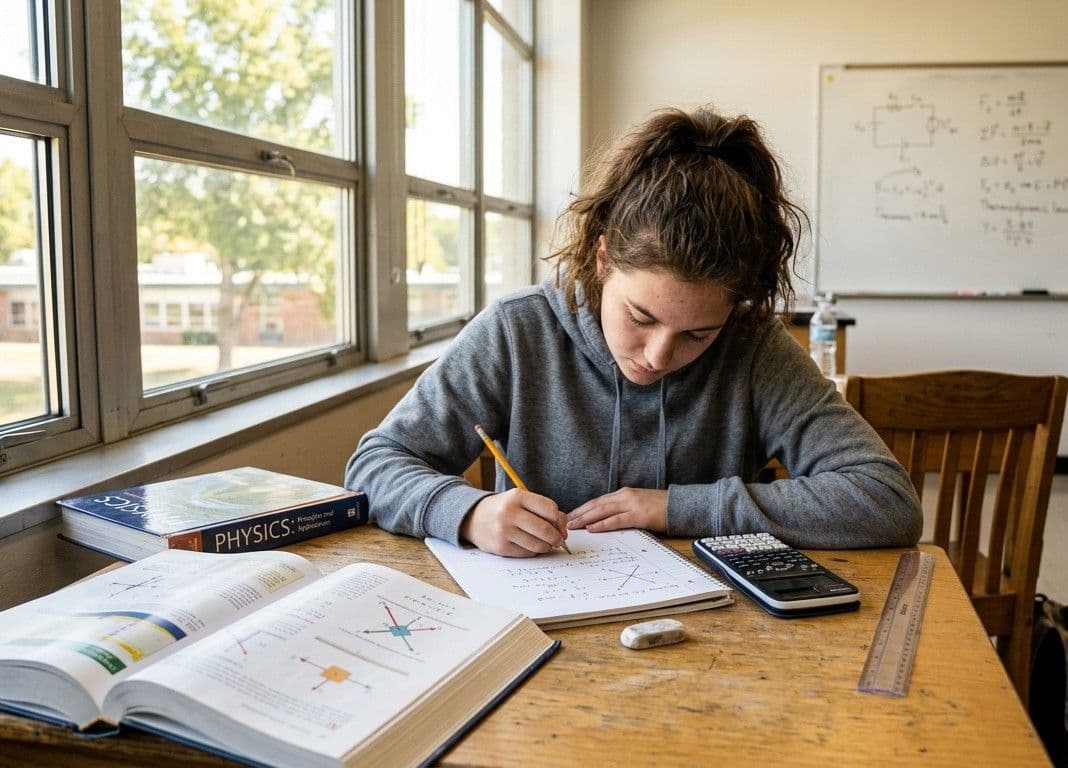

Physics Tutor in Brentwood, Burnaby — PhD-Led, In-Person & Online
Why Physics Feels Like a Wall — and What's Really Going On
If you're searching for a physics tutor in Brentwood, Burnaby, there's a good chance physics has stopped feeling like a subject and started feeling like a wall. A student who used to do fine in math suddenly hits Physics 11 and the marks slide. The homework gets done, the formulas get memorised — and then the test comes back with red ink all over it.
Here's the part most people miss: that wall is almost never about ability. It's about small concept gaps that compound. Physics is unusually unforgiving that way. If you don't truly understand what a vector is, forces in two dimensions become impossible. If free-body diagrams never clicked, then Newton's second law is just a formula you're shoving numbers into and hoping. Each shaky foundation makes the next topic harder, until a capable student is convinced they're "just not a physics person."
They almost always are. We've seen it again and again across Burnaby and Metro Vancouver: the moment the why behind a concept finally lands, the student stops guessing and starts reasoning. That's the whole game.
At Dr. Shreyank Educare, we're a PhD-led practice — Dr. Shreyank Gupta (Ph.D.) sets the method and the quality bar, and a team of qualified tutors delivers it one-on-one, whether you're sitting across the table at our Burnaby location or working online from anywhere in Metro Vancouver. We don't drill symptoms. We diagnose the gap underneath the grade.
Not sure where the gap actually is? Book a free assessment — no pressure, just a clear picture of what's going on.
The Real Reason Burnaby Students Struggle With Physics 11 and 12
Physics in BC schools moves fast. Physics 11 asks students to hold several new ideas at once — kinematics, forces, energy, momentum, waves — and most of them require a comfort with algebra and a physical intuition that isn't taught directly. Physics 12 raises the stakes with dynamics in two dimensions, circular motion, electric fields, and more, often while students are also juggling Pre-Calculus 12 and Chemistry 12.
The usual breakdown points we see in Brentwood-area students:
- Kinematics. Students memorise the equations but can't tell which one to use because they don't understand what each variable represents physically.
- Free-body diagrams. Skipped or rushed — and everything in dynamics depends on them.
- Vectors. Treating a vector like a plain number is the single most common source of "I did everything right but got it wrong."
- Energy and momentum. Students apply conservation blindly without checking whether the quantity is actually conserved in that scenario.
- Unit tracking. A surprising number of lost marks come from mixing cm and m, or forgetting that acceleration is m/s².
Take a classic Physics 11 kinematics problem. A student memorises the five equations and panics about which to pick. We teach them to read the problem for what's known and unknown first. If you know initial velocity, acceleration, and time, and you want displacement:
Δx = v₀·t + ½·a·t²
And if you know velocities and acceleration but not time, you reach for:
v² = v₀² + 2·a·Δx
The skill isn't memorising both — it's recognising which quantities you have so the right tool is obvious. Once a student sees the equations as a toolkit rather than a wall of symbols, the panic drops away.
How a PhD-Led Method Actually Changes the Way Physics Is Taught
Most tutoring looks like this: the student brings homework, the tutor helps finish it, everyone feels productive, and nothing fundamental changes. The grade might tick up for one test, then slide again, because the underlying gap was never touched.
Our approach is different because it starts with a diagnosis. Before we teach anything, we figure out where the understanding actually broke. A student failing momentum problems in Physics 12 might really have an unresolved gap in vector addition from Physics 11 — fix that, and momentum suddenly makes sense. This is what we mean by "concept gaps that compound." You can't out-drill a broken foundation.
The PhD lens matters here, and not as a marketing badge. When you've done research-level physics, you understand the structure of the subject — how ideas connect, which principles are load-bearing, and why students stumble in predictable places. That's what shapes the method every tutor on our team follows. (To be clear: the PhD leads and oversees the practice and sets the standard — he isn't necessarily the tutor in every single session.)
A good example is how we handle Newton's second law. Students learn F = m·a and think they know it. But the version that actually solves problems is:
ΣF = m·a
The Σ (sum of all forces) is the whole point. We slow down and make sure a student can draw every force on the object, add them as vectors, and only then apply the equation. Get that habit right once and dynamics stops being terrifying.
We also teach in-person in Burnaby for students who focus better face-to-face, and online across Metro Vancouver — Vancouver, New Westminster, Coquitlam, Richmond, Surrey, North Vancouver — for families who want the convenience without the commute. The method is identical; only the delivery changes. You can read more about how we structure sessions on our physics tutoring programs page.
Want physics to finally make sense instead of just getting "survived"? Book a free assessment and we'll show you exactly where the gap is — zero risk, zero pressure.
In-Person in Brentwood vs. Online Across Metro Vancouver — Which Is Right?
Brentwood is one of Burnaby's busiest, most connected neighbourhoods — right on the SkyTrain, close to schools across the north Burnaby area. That makes in-person physics tutoring genuinely convenient for a lot of families. For many students, sitting beside a tutor who can point at a free-body diagram, watch where their pencil hesitates, and catch a misconception in real time is the fastest way to progress.
That said, online physics tutoring has become remarkably effective. With a shared digital whiteboard, we can work through kinematics graphs, draw vectors, and solve problems together in real time — and the student keeps every page of notes afterward. For busy Metro Vancouver families, skipping the drive can mean the difference between tutoring happening consistently and not happening at all.
Our honest advice: younger students and those who are easily distracted often do best in-person to start. Independent, motivated high-schoolers frequently thrive online. And many families mix both. There's no wrong answer — we'll help you choose during the free assessment. If you'd like to talk it through first, just reach out through our contact page.
A Worked Example: From "I Don't Get It" to "Oh — That Makes Sense"
Let's walk through a real type of Physics 12 problem the way we'd teach it, because it shows the method in action.
A 2.0 kg object slides down a frictionless incline angled at 30°. What is its acceleration down the slope?
A memorisation-first student freezes: which formula? A student we've taught thinks structurally instead. Step one: draw the free-body diagram. Two forces — gravity straight down, and the normal force perpendicular to the surface. Step two: the key insight — gravity is the only force with a component along the slope, and that component is:
F∥ = m·g·sin θ
Step three: apply ΣF = m·a along the slope. The mass cancels (a lovely result students find satisfying once they see it):
a = g·sin θ = 9.8 · sin 30° = 9.8 · 0.5 = 4.9 m/s²
Notice what happened: we never reached for a random equation. We reasoned from a diagram and Newton's second law, and the answer fell out. That transferable process — diagram, components, ΣF = m·a — works for hundreds of problems. That's the difference between a grade bump and real learning.
This same philosophy runs through everything we teach, from Chemistry 11 and 12 to Pre-Calculus and university-level courses.
Beyond Physics 11/12: AP, IB, SAT, and University-Level Help
Physics doesn't end at the BC provincial curriculum, and neither do we. For students pushing further, our team covers:
AP Physics (1, 2, and C). These demand deeper conceptual reasoning and, for Physics C, calculus-based mechanics and electromagnetism. We make sure the calculus and the physics reinforce each other rather than becoming two separate struggles.
IB Physics (SL and HL). The IB's emphasis on data analysis, uncertainties, and the Internal Assessment catches many students off guard. We help with both the content and the scientific reasoning the IB rewards.
SAT and exam prep. For students aiming at competitive admissions, we also run SAT preparation in Math and Reading & Writing, built on the same understanding-first approach.
University first-year physics. Students heading to UBC or SFU often hit first-year physics (think UBC's PHYS 100-level courses or SFU's introductory physics sequences) and discover the pace is relentless. Early help bridging high-school intuition to university rigour saves a lot of stress. Adult learners upgrading for a program change are welcome too.
Whatever the level, the goal is the same: genuine understanding and the confidence that comes with it — and yes, the grades that tend to follow.
What Progress Actually Looks Like (Honestly)
We won't promise a specific grade — nobody credible can, and we'd rather tell you the truth. What we can describe is the pattern we see when a student sticks with the method.
First comes relief. The "fog before the exam" starts to lift once a student realises physics has an underlying logic they can follow. Next comes willingness — they stop avoiding homework because it no longer feels hopeless. Then comes transfer: they start solving new problem types they've never seen, because they understand the principles rather than pattern-matching to memorised examples. That last stage is the real prize, and it's usually when marks move for good.
How long it takes depends on where the gaps are and how consistently a student shows up. A single foundational gap might resolve in a few focused sessions; a student rebuilding from several compounded gaps needs more runway. The free assessment is where we give you an honest read on which situation you're in. You can also browse our blog for more on how students actually learn and why cramming fails.
Ready to Make Physics Click? Book Your Free Assessment
If physics has become the subject your family dreads, you don't have to keep guessing at what's wrong. A physics tutor in Brentwood, Burnaby who diagnoses the real gap — instead of just helping finish tonight's homework — changes everything.
Start with a free, no-pressure assessment. We'll pinpoint exactly where the understanding broke down and map out a plan to fix it, whether you choose in-person in Burnaby or online across Metro Vancouver.
Book your free assessment at drshreyankeducare.com/book, or simply call or text us at 672-514-7587. No obligation, no hard sell — just a clear next step toward physics finally making sense.
Frequently Asked Questions
Do you offer in-person physics tutoring in Brentwood, Burnaby?
Yes. We tutor in-person in Burnaby, convenient for students in Brentwood and across north Burnaby, and we also teach online across Metro Vancouver — Vancouver, New Westminster, Coquitlam, Richmond, Surrey, and North Vancouver. The method is identical either way; we'll help you pick the format that fits your student best during the free assessment.
Does a PhD teach every session?
We're a PhD-led practice. Dr. Shreyank Gupta (Ph.D.) sets the method and the quality standard, and a team of qualified tutors delivers it one-on-one. The PhD leads and oversees the practice — he isn't necessarily the tutor in every individual session, but every session follows the same understanding-first approach he designed.
Can you help with AP, IB, and university physics, not just Physics 11/12?
Absolutely. We cover BC Physics 11 and 12, AP Physics (including calculus-based Physics C), IB Physics SL/HL, and first-year university courses at the UBC/SFU level, plus adult upgrading. We match the tutor and approach to the specific course and goal.
How much does it cost, and is the first assessment really free?
The initial assessment is genuinely free and carries no obligation — it's how we identify the real concept gaps before recommending anything. For current session rates and options, just book the free assessment or call/text 672-514-7587 and we'll walk you through everything with no pressure.
Frequently Asked Questions
Do you offer in-person physics tutoring in Brentwood, Burnaby?
Yes. We tutor in-person in Burnaby, convenient for Brentwood and north Burnaby students, and also online across Metro Vancouver including Vancouver, New Westminster, Coquitlam, Richmond, Surrey, and North Vancouver. The method is identical — we'll help you choose the best format at the free assessment.
Does a PhD teach every session?
We're a PhD-led practice. Dr. Shreyank Gupta (Ph.D.) sets the method and quality standard, and a team of qualified tutors delivers it one-on-one. The PhD leads and oversees the practice — he isn't necessarily the tutor in every session, but every session follows his understanding-first approach.
Can you help with AP, IB, and university physics, not just Physics 11/12?
Yes. We cover BC Physics 11 and 12, AP Physics (including calculus-based Physics C), IB Physics SL/HL, first-year university physics at the UBC/SFU level, and adult upgrading. We match the tutor and approach to the specific course and goal.
How much does it cost, and is the first assessment really free?
The initial assessment is genuinely free with no obligation — it's how we find the real concept gaps before recommending anything. For current rates and options, book the free assessment online or call/text 672-514-7587 and we'll explain everything with no pressure.
Need one-on-one help with this? Our tutors can guide you step by step.
Physics Tutoring