
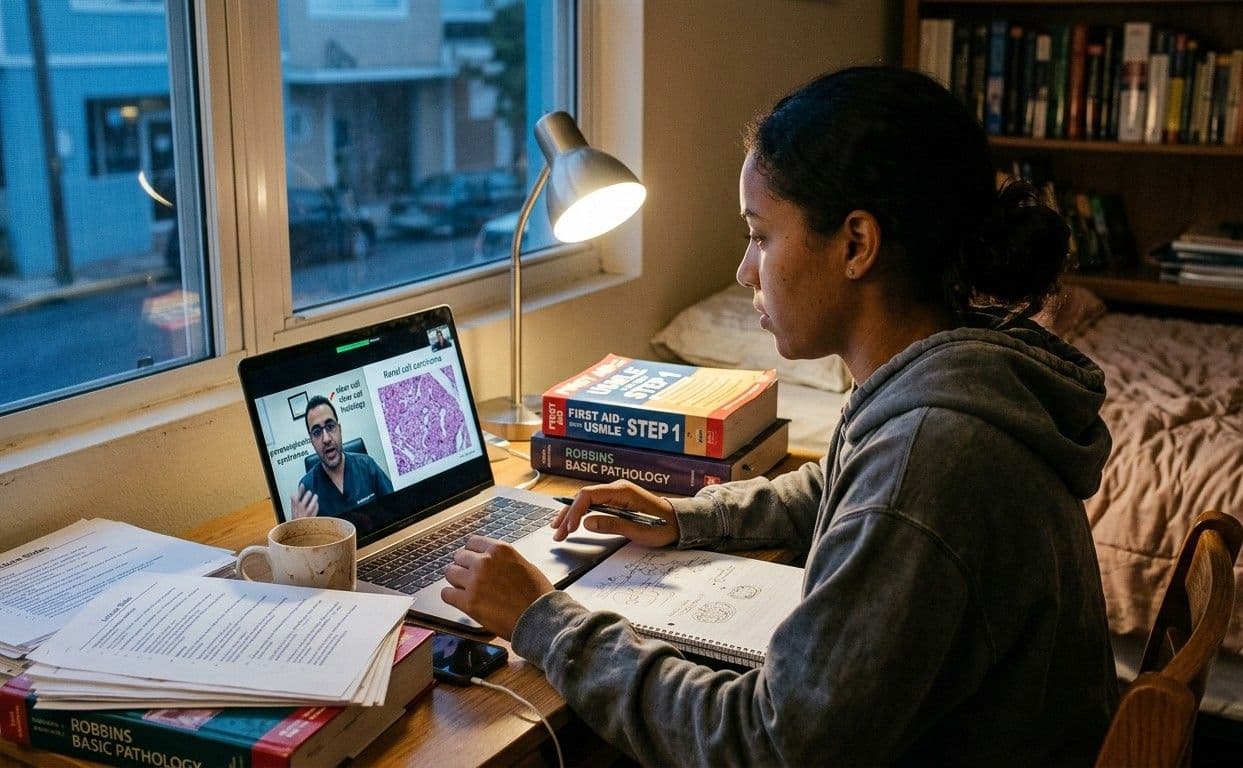
Online Medical Tutoring for USA & Caribbean Medical Students: The Complete Guide
Online medical tutoring pairs a medical student with a qualified doctor (MD) for one-on-one, virtual sessions in subjects like physiology, pathology, pharmacology and anatomy or for board exam preparation such as the USMLE. It is used by students in the USA and the Caribbean who need more than a lecture hall or a textbook can give them — a tutor who understands both the material and how it is actually tested.
If you are a medical student in the USA or at a Caribbean medical school and searching for the right kind of support, this guide covers what online medical tutoring actually involves, how it differs across USA and Caribbean programs, what MD-led tutoring means in practice and how to choose a tutor who will genuinely move your grades and board scores.
What Is Online Medical Tutoring?
Online medical tutoring is one-on-one academic support, delivered over video call, for students enrolled in medical school or preparing for medical licensing exams. Unlike a general tutoring service, medical tutoring is subject-specific and exam-specific: sessions are built around a real medical curriculum — physiology, pathology, pharmacology, biochemistry, anatomy, microbiology and immunology or around board exams like the USMLE Step 1 and Step 2 CK.
The "online" part matters as much as the "medical" part. Medical students move constantly between campuses, clinical rotations, and countries and a virtual format means a student can keep the same tutor and the same study plan throughout, regardless of location. That consistency is often the difference between tutoring that helps and tutoring that just adds another commitment to the calendar.
Why "MD-Led" Matters
Not all medical tutors are doctors. Many are graduate students, senior medical students, or general science tutors who know the content but haven't applied it clinically. An MD-led online medical tutor has actually practiced medicine which changes what happens in a session in three concrete ways:
- Clinical framing, not just recall. An MD-led tutor explains why a physiological mechanism matters at the bedside, not just what it is, which is also how board exams increasingly test.
- Exam pattern recognition. Doctors who have taken (and often helped others prepare for) the USMLE know which concepts are tested repeatedly versus which are textbook noise.
- Judgment on what to skip. A qualified doctor can tell a struggling student what not to spend time on, which matters more the closer a student gets to exam day.
This is the core distinction behind terms like MD-led online medical tutor Caribbean or MD-led USMLE prep: the tutor isn't reciting a syllabus, they are teaching the way a clinician thinks.
Online Medical Tutoring in the USA
Online medical tutoring in the USA typically supports students at two stages:
- Pre-clinical years (MS1–MS2): dense, fast-moving coursework in physiology, pathology, pharmacology, biochemistry and anatomy, often delivered through pass/fail or block-based systems where falling behind in one block compounds quickly.
- Clinical years and board prep (MS3–MS4): integrating classroom knowledge with rotations, alongside preparation for USMLE Step 1, Step 2 CK and shelf exams.
For US medical school tutoring, the biggest recurring challenge isn't intelligence — most students accepted into a US MD or DO program are academically strong. The challenge is volume and pacing: medical school compresses years of undergraduate biology into months. A tutor's real job is diagnostic — finding the specific conceptual gap (say, a shaky grasp of renal acid-base physiology) before it quietly undermines three other topics built on top of it.
An online medical tutor for USA students should be able to work directly from the student's own course material — lecture slides, syllabus, practice questions rather than teaching a generic version of the subject that doesn't map to how the student will actually be tested.
Online Medical Tutoring in the Caribbean
Caribbean medical schools serve a large number of students pursuing MD pathways outside the traditional US admissions route, and medical school tutoring in the Caribbean has some distinct realities worth naming:
- Accelerated, intensive terms. Many Caribbean MD programs run on compressed academic calendars with limited breaks, leaving little room to recover from falling behind in a course.
- Distance from campus support. Students are often studying far from family and academic support structures can vary significantly between institutions — making a reliable outside tutor more valuable, not less.
- A clear eye on Step exams from day one. Because Caribbean-trained graduates are typically judged heavily on USMLE performance for US residency matching, board exam readiness isn't a final-year concern — it shapes how pre-clinical subjects should be studied from the start.
This is why online medical tutoring in the Caribbean works best when it isn't just subject tutoring in isolation, but subject tutoring with an eye on how physiology, pathology and pharmacology will resurface on Step 1 and Step 2 eighteen months later.
Online USMLE Tutoring for Caribbean Students
Online USMLE tutors in the Caribbean typically support three phases of preparation:
- Foundation building — closing content gaps in physiology, pathology and pharmacology while there's still runway before dedicated study time.
- Systems-based review — working through organ systems (cardiovascular, renal, GI, endocrine, etc.) the way the exam actually tests them, rather than by course.
- Final dedicated period — high-yield review, timed question blocks, and error-log analysis to find recurring mistake patterns before test day.
Because Step 1 is scored pass/fail while Step 2 CK carries a three-digit score that plays a significant role in residency applications, many Caribbean students concentrate tutoring hours around Step 2 CK once Step 1 is cleared though a strong Step 1 foundation still shapes how quickly Step 2 content clicks.
A useful question to ask any prospective tutor: how do you structure a study plan differently for Step 1 versus Step 2 CK? A vague answer is a signal to keep looking.
Subjects Covered in Medical School Tutoring
Most medical school tutoring for USA and Caribbean students alike centers on the core pre-clinical sciences:
- Physiology — organ system function and integration
- Pathology — disease mechanisms and the changes they cause
- Pharmacology — drug classes, mechanisms, and clinical use
- Anatomy & Histology — structural and microscopic foundations
- Biochemistry — metabolic pathways and their clinical relevance
- Microbiology & Immunology — pathogens, host defense, and infection
Each of these plays a different, specific role on board exams, which is part of why generic science tutoring rarely translates well to medical school — the depth and clinical application expected is materially different.
How Online Medical Tutoring Sessions Work
A well-structured online medical tutoring engagement usually follows a simple arc:
- Free consultation. A short call to understand the student's current course or exam stage, specific weak areas, and timeline.
- Diagnostic conversation. Rather than starting from a generic curriculum, the tutor identifies exactly where the student's understanding breaks down.
- Tailored study plan. Sessions are built around the student's actual coursework or exam blueprint, not a one-size-fits-all syllabus.
- Weekly one-on-one sessions. Delivered by video call, with a consistent tutor who tracks progress and adjusts focus week to week.
- Progress check-ins. As concepts solidify, sessions shift from concept-building toward practice questions, timed review, and exam strategy.
Who Online Medical Tutoring Is For
- USA medical students in pre-clinical or clinical years who are falling behind or want to build a stronger margin before exams
- Caribbean medical school students navigating intensive terms with less built-in academic support
- Students at any stage preparing for USMLE Step 1 or Step 2 CK
- Students who understand material in lecture but struggle to apply it under exam conditions
- Anyone who has tried self-study or group study and needs focused, individual attention on specific weak areas
How to Choose an Online Medical Tutor
Before committing to a tutor or program, it's worth asking a few direct questions:
- Is the tutor an MD, and do they teach the subject clinically or just from a textbook?
- Will sessions be built around my actual course material, or a generic curriculum?
- How is progress tracked between sessions?
- Can the tutor explain how they'd adjust a study plan for my specific exam timeline?
- Is scheduling flexible enough to work around clinical rotations or time zones?
A tutor who can answer these clearly and who offers a genuine diagnostic conversation before proposing a plan is a much stronger bet than one who leads with a fixed package.
Ready to Get Started?
If you are a USA or Caribbean medical student weighing whether online tutoring is the right move, the fastest way to find out is a short conversation about where you're stuck and what your timeline looks like.
Book a Free 30-Minute Consultation →
Explore related tutoring pages:
Need one-on-one help with this? Our tutors can guide you step by step.
Explore Our Tutoring Programs