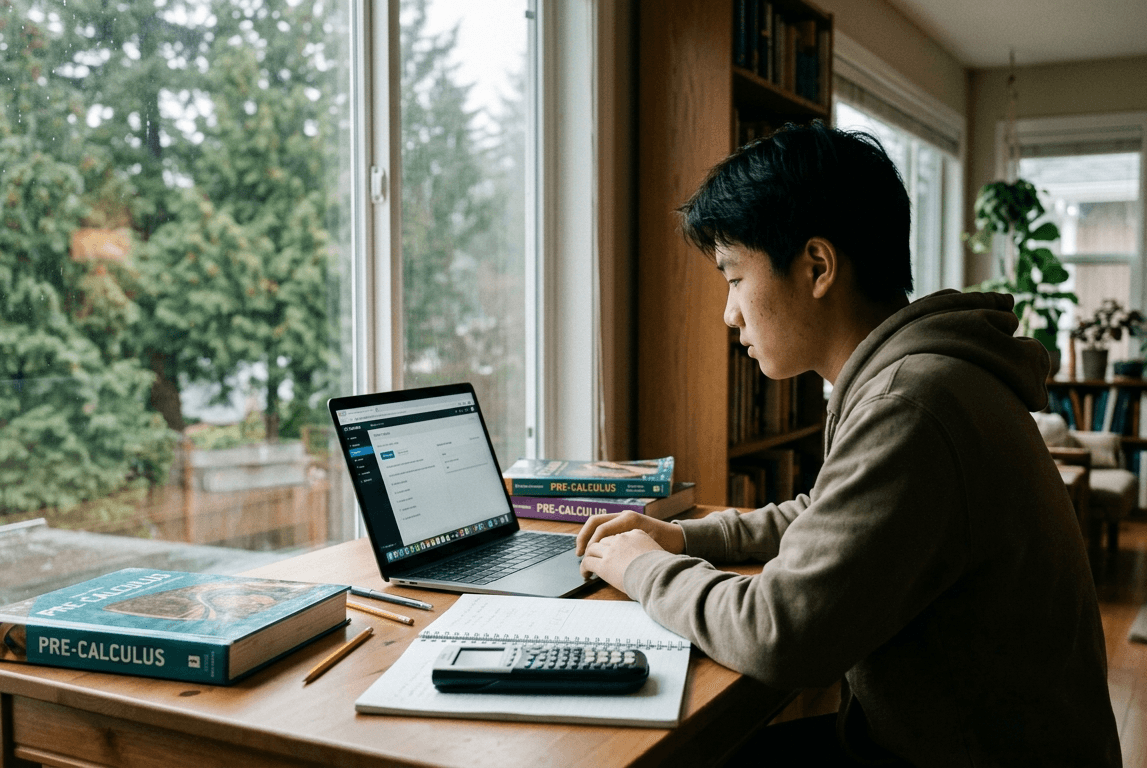

The Critical Importance of High School Mathematics
Every parent of a teenager has probably heard the question, usually in a moment of frustration over homework: 'When am I ever going to use this?' It is a fair question, and it deserves a better answer than 'because it is on the test'. High-school mathematics is far more important than many students realise, and not only for the obvious reason that it is required for graduation and university. It shapes which careers and programs remain open to a student, it builds ways of thinking that serve them for life, and it is a genuine gateway that, once closed, is hard to reopen. Understanding why high-school maths matters so much can transform a student's — and a parent's — attitude toward it.
High-school mathematics matters far more than most students realise, for reasons well beyond passing exams. This guide covers why it is so important — as a gateway to opportunities, as training for the mind, and as a genuinely useful life skill — so students and parents can see the real stakes.
Maths is a gateway that quietly opens or closes doors
The most immediate reason high-school mathematics matters is that it functions as a gatekeeper to a huge range of future opportunities. Many university programs and careers — not only in obvious fields like engineering and science, but in business, economics, medicine, computing, and beyond — require specific mathematics courses, especially at the senior high-school level. A student who does not complete these courses, or does poorly in them, finds those paths quietly closed, often before they have even decided what they want to do.
This is what makes high-school maths so consequential: decisions made in these years, sometimes without full awareness of the stakes, can shape a student's options for years afterward. Dropping a maths course, or letting a grade slide, can eliminate possibilities that a student may later wish they had kept open. Because so many doors depend on it, keeping up with mathematics through high school is one of the most important things a student can do to preserve their future choices. Understanding that maths is a gateway — that keeping it strong keeps options open — is often what motivates students to take it seriously before it is too late.
Maths trains the mind, whatever you do with it
Beyond opening specific doors, high-school mathematics develops ways of thinking that benefit a student in every area of life, whether or not they ever use the specific content again. Mathematics is training in logical reasoning — in following a chain of steps rigorously, in constructing and evaluating arguments, in thinking precisely. These are among the most transferable and valuable skills a person can develop, and they strengthen thinking in every subject and every career.
Mathematics also builds problem-solving ability — the capacity to approach an unfamiliar challenge systematically, break it down, and work toward a solution. It develops persistence and mental discipline, because working through difficult problems teaches you to keep going. And it fosters the analytical, quantitative reasoning that modern life and work increasingly demand. So even a student who never directly uses trigonometry again benefits enormously from having learned it, because of how it shaped their thinking. Understanding that maths trains the mind in ways that transfer everywhere is what reveals its value even to students who do not plan a mathematical career.
Maths is genuinely useful in real life
Contrary to the complaint that maths is impractical, high-school mathematics is genuinely useful in everyday life and in nearly every career, often in ways students do not anticipate. Managing money — budgeting, understanding interest and loans, making financial decisions — is applied mathematics, and financial literacy rests directly on the maths learned in school. Understanding statistics and data, increasingly essential in a data-saturated world, depends on mathematical foundations.
Everyday reasoning is full of mathematics too: estimating, comparing options, understanding risk and probability, interpreting the numbers and graphs that fill the news. A person comfortable with mathematics navigates all of this more confidently and is less easily misled. And across careers — from trades that use measurement and geometry to professions that use data and modelling — mathematical skills are constantly applied. Recognising that high-school mathematics is not abstract busywork but a genuinely useful toolkit for life and work is what answers the 'when will I use this?' question honestly: constantly, and often without realising it.
If your child is struggling with or dismissing high-school maths, understanding what is really at stake — and getting the right support — protects opportunities they may not yet know they want. Our math tutoring in Burnaby and across Metro Vancouver keeps students on track and their options open, building both skills and confidence.
What mathematics actually is
Part of why students undervalue mathematics is that they misunderstand what it fundamentally is. Mathematics is not really about arithmetic or memorising formulas — those are just tools. At its core, mathematics is the study of patterns, structures, and logical relationships, a way of finding order and reasoning about it with certainty. It is, in a real sense, the language in which the universe seems to be written, which is why it describes everything from the orbits of planets to the growth of populations.
Seeing mathematics this way — as a powerful, elegant system for understanding patterns and reasoning rigorously — changes how a student relates to it. The abstraction that can feel pointless is actually its strength: because mathematical truths are general, they apply everywhere, which is why the same equations describe phenomena across wildly different fields. There is also genuine beauty in mathematics, in the way disparate ideas connect and simple principles explain complex things, that students rarely get to see when it is presented only as procedures to memorise. Understanding what mathematics really is helps a student appreciate why it has been central to human thought for millennia and why it remains so, which is a far more motivating view than seeing it as arbitrary busywork.
Mathematics in the age of technology and data
If mathematics has always mattered, it matters more than ever in an age defined by technology, data, and artificial intelligence. Every one of these transformative forces is built on mathematics: the algorithms that run our digital world, the data analysis that drives decisions in every field, and the machine learning behind artificial intelligence all rest on mathematical foundations. The modern economy increasingly rewards those who can work with quantitative and computational ideas, and mathematical skill is a gateway to the fields shaping the future.
This gives high-school mathematics a new urgency. The students who will thrive in the coming decades are, in large part, those comfortable with the mathematical and quantitative thinking that technology and data demand — and that comfort is built on the foundation laid in school. Even careers that do not seem mathematical increasingly involve data and technology that reward quantitative literacy. Recognising that mathematics is not a relic but the foundation of the most important developments of our time gives high-school maths a relevance that speaks directly to students wondering whether it is worth the effort. In a data-driven, technology-shaped world, strong mathematical foundations are more valuable than they have ever been.
Why students give up on maths, and why they should not
Many students who could succeed at mathematics give up on it, usually not for lack of ability but because of a specific gap that made everything harder, combined with a loss of confidence and the damaging belief that they are 'not a maths person'. This belief is largely a myth — mathematical ability grows with effort and good teaching — but it becomes self-fulfilling when a student stops trying. Given the stakes, this giving-up is genuinely costly, closing doors and forfeiting benefits the student may deeply regret later.
The encouraging truth is that struggling with maths is almost always a solvable problem, not a verdict on ability. A specific gap can be found and fixed; confidence can be rebuilt through genuine success; and a student who was ready to give up can get back on track. Because the consequences of abandoning maths are so significant, and because the difficulties are so often fixable, helping a struggling student persist — with the right diagnosis and support — is one of the most valuable interventions in their education. Understanding that maths difficulties are addressable, and that the stakes make addressing them worthwhile, is what turns a student away from giving up and toward keeping their future open.
Why high-school maths is more important than it seems
- It gatekeeps university programs and careers, often before students decide.
- Dropping or neglecting it quietly closes doors that are hard to reopen.
- It trains logical reasoning and problem-solving that transfer everywhere.
- It underpins financial literacy, data literacy, and everyday reasoning.
- Students who give up usually could have succeeded with the right help.
How to take high-school maths seriously
- Recognise maths as a gateway and keep it strong to preserve options.
- Value the thinking skills it builds, not just the specific content.
- See its genuine usefulness in money, data, and everyday reasoning.
- Reject the 'not a maths person' myth — ability grows with effort.
- Address struggles early, since they are usually fixable and the stakes are high.
Keep your child's future open
If high-school maths is a struggle in your household, the stakes are higher than a single grade — and the difficulties are almost always fixable with the right support. Our math tutoring in Burnaby and across Metro Vancouver finds and fixes the real gaps, rebuilds confidence, and keeps the doors that maths gatekeeps firmly open.
The first step is a free, friendly conversation. Book a free 30-minute consultation, tell us how the maths is going, and we will help you understand what is at stake and what will help — online across Metro Vancouver, or in person in Burnaby. If tutoring is not what your child needs, we will say so honestly.
Need one-on-one help with this? Our tutors can guide you step by step.
Math Tutoring