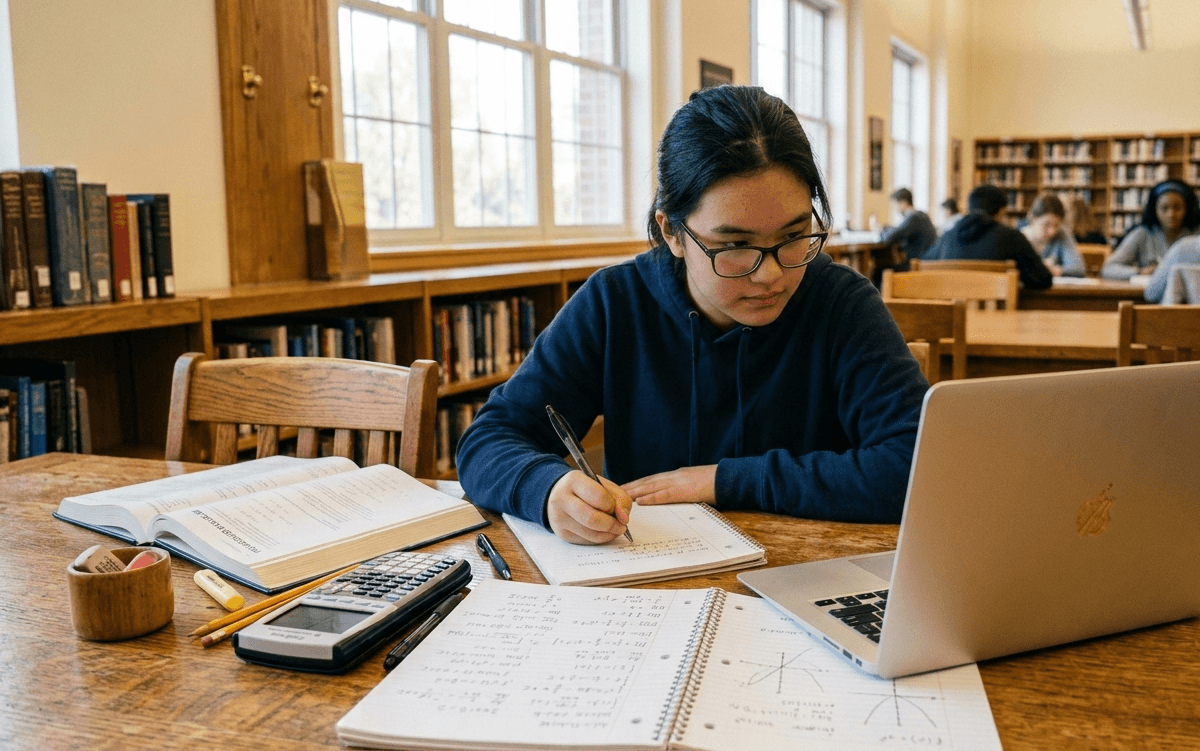

University Biology Tutoring in Vancouver: UBC & SFU Course Help
University Biology Isn't Memorisation — Even Though It Feels Like It
Ask ten first-year students why biology is hard and nine will say the same thing: "there's just so much to memorise." They're describing the symptom, not the disease. The students who struggle in UBC's BIOL 112 or SFU's BISC 101 aren't the ones who memorise too little — they're the ones who memorise instead of understanding, and then watch it evaporate the night before the midterm.
Here's the truth the syllabus won't tell you: university biology is a mechanism subject wearing a vocabulary subject's clothing. Once you see why a process happens — why a membrane is selectively permeable, why an allele frequency shifts — the hundred facts around it stop being a list to cram and become consequences you can reason out. That shift is the entire difference between a C and an A, and it's what a good university biology tutor in Vancouver is actually for.
The Courses and Topics We Help With
We support first- and second-year university biology across Metro Vancouver — the whole introductory arc:
- Cell & molecular biology — membranes, transport, respiration, photosynthesis, the cell cycle
- Genetics — Mendelian inheritance, linkage, population genetics, molecular genetics
- Biochemistry — enzymes, kinetics, metabolism, pH and buffers
- Physiology — the systems, homeostasis, signalling
- Ecology & evolution — selection, population dynamics
- Labs & lab reports — experimental design, data analysis, and the write-ups that quietly sink your grade
That maps onto courses like UBC BIOL 111 / 112 / 121 / 200 / 201, SFU BISC 100 / 101 / 102, and the introductory biology streams at Langara and KPU. Not sure your course fits? Send us the code and the topics — we'll tell you honestly whether we're the right help. (You can see how we approach one of these on our cell biology deep-dive.)
Genetics: The Math Nobody Warns You About
Students walk into biology expecting no math — and then genetics hands them algebra. This is where "memorisers" fall off a cliff and "understanders" pull ahead.
Take population genetics. The Hardy-Weinberg principle says that in an idealised population, allele and genotype frequencies stay constant, and:
p + q = 1 and p² + 2pq + q² = 1
where p and q are the two allele frequencies, p² and q² are the homozygote frequencies, and 2pq is the heterozygote frequency. Memorise that and you can plug numbers in. But understand it — that it's just the algebra of "what happens when you randomly pair up two alleles" — and you can answer any variation the exam throws at you, including the "carrier frequency" questions that trip up half the class.
The same goes for testing whether your dihybrid cross results are "close enough" to the expected 9:3:3:1 ratio. That's not a memorised rule — it's a chi-square test:
χ² = Σ (O − E)² / E
compare observed (O) to expected (E), and check it against the critical value. Students who memorised "9:3:3:1" freeze the moment a question asks them to justify it. Students who understand χ² just do it.
Cell Biology & Biochemistry: Where Mechanism Beats Memory
Biochemistry is the other place the memorise-only strategy collapses — usually at enzyme kinetics. The Michaelis–Menten equation,
v = (Vₘₐₓ · [S]) / (Kₘ + [S])
looks like something to memorise. It isn't. It's a story: at low substrate concentration the reaction rate climbs almost linearly; as substrate floods in, the enzyme saturates and the rate flattens toward Vₘₐₓ; and Kₘ is simply the substrate concentration at half of Vₘₐₓ — a measure of how tightly the enzyme grips its substrate. Understand that story and inhibition graphs (competitive vs non-competitive) stop being flashcards and start being predictions.
Even something as small as pH matters here. In buffers and physiology, pH = −log[H⁺] isn't trivia — it's why a one-unit pH change means a tenfold change in hydrogen-ion concentration, and why enzymes denature outside a narrow range. These aren't separate facts to memorise. They're the same idea, seen from different angles — which is exactly how we teach them.
Physiology, Ecology and the Rest of the Syllabus
The later units — physiology, ecology, evolution — reward the same habit. Homeostasis is just negative feedback; a population growth curve is just a differential equation you can read (dN/dt = rN for exponential, bending toward carrying capacity K for logistic). When you stop treating each unit as a fresh pile of terms and start seeing the recurring principles, the volume of the course finally becomes manageable.
Our Method: Understanding, Not Memorising
This is the core of how we work, and it's the whole difference. We don't hand you a longer list of things to memorise. We find the concept gap underneath the bad grade — usually earlier in the course than you'd guess — and fix that, so the material downstream stops collapsing.
A shaky grip on the cell membrane in week two quietly sabotages transport, then respiration, then physiology. "Do more practice questions" doesn't help, because the practice is downstream of the break. Find the break, repair the understanding, and the rest falls into place. It's the same principle whether it's Hardy-Weinberg, enzyme kinetics, or a lab write-up.
What a Session Actually Looks Like
We don't start by "reviewing chapter four." We start by finding the gap.
First we diagnose — working through your real course material and recent problem sets to locate where the understanding actually broke. Then we do targeted work on that root cause, building back up to where your class is now. Then we practise under real conditions — past midterms, the question styles your instructor favours, and the lab-report expectations that lose so many easy marks.
Sessions run in person in Burnaby or online across Metro Vancouver — Vancouver, New Westminster, Coquitlam, Richmond, Surrey, North Vancouver. It's a PhD-led practice: Dr. Shreyank Gupta (Ph.D.) sets the method and the quality bar, and a team of qualified tutors delivers that same understanding-first approach across biology, chemistry, physics and math. You get PhD-level rigour and a consistent method — not a franchise script, and not a lone undergrad improvising.
Getting Help Before It Becomes a Crisis
The students who recover fastest are the ones who reach out when biology starts slipping — not the week before the final. The fastest first step is a free assessment: no cost, no pressure, just a clear read on where the understanding broke and a plan to fix it.
Book a free assessment or call/text 672-855-8577. Prefer to ask a question first? Contact us here.
Frequently Asked Questions
Can you help with UBC and SFU biology courses?
Yes — we regularly support first- and second-year biology, including UBC BIOL 111/112/121 and SFU BISC 101/102, plus Langara and KPU equivalents. Send your course code and topics and we'll confirm it's a fit.
I'm not a "math person" — is genetics going to be a problem?
That's exactly what we're for. The math in genetics (Hardy-Weinberg, chi-square, ratios) is small and learnable once you understand why it works — and we teach it that way, not as formulas to memorise.
Do you help with labs and lab reports?
Yes — experimental design, data analysis, and the write-up itself. We work through them with you so the next one is yours to handle.
My midterm is soon — is it too late?
No. We'll prioritise the highest-impact concepts and past-exam practice for your specific course. We won't promise a particular grade — no honest tutor can — but you'll walk in understanding far more than you do now.
Need one-on-one help with this? Our tutors can guide you step by step.
University Biology Tutoring