What Is Engineering Statics and Why It Trips Up First-Year Engineering Students
If you are a first-year engineering student in Burnaby or Vancouver, there is a good chance one course is already keeping you up at night: Engineering Statics. Ask any second- or third-year student at SFU, BCIT, UBC or Douglas College which course marked the real start of their engineering degree and Statics is almost always on the list.
It isn't that the material is impossible. It's that Statics asks students to think in a completely new way and most first-year students walk in without that skill yet. At Dr. Shreyank Educare, we work with engineering students across Burnaby and Vancouver every semester who hit the same wall in Statics, so we have seen exactly where things go wrong and how to fix it.
What Is Engineering Statics, Exactly?
Engineering Statics is the study of forces acting on objects that are not moving bridges, beams, trusses, brackets, machine frames and building supports that are in equilibrium. The core idea sounds simple: if something isn't accelerating, the sum of all forces and moments acting on it must equal zero.
In practice, that "simple" idea becomes the foundation for everything that follows in a mechanical, civil or structural engineering program. Statics is typically the first course where students:
- Translate a real-world structure into a simplified diagram (a free body diagram)
- Apply vector math to physical forces instead of abstract numbers
- Solve for unknown forces using systems of equations
- Reason about a 3D object using 2D representations
It's usually taken in the first or second semester of an engineering program, right alongside Calculus and an introductory Physics course which is part of why it feels so overwhelming.
Why Statics Trips Up So Many First-Year Students
1. It's the first course that demands "engineering thinking"
High school physics and first-year Calculus are mostly about applying formulas. Statics is different — it asks you to look at a real object, decide what's holding it up, sketch it correctly, and then figure out which equations apply. There's no single formula to memorize. That shift from "plug and chug" to genuine problem framing is where most students get stuck.
2. Free body diagrams are deceptively hard
Almost every Statics problem starts with drawing a free body diagram (FBD) and almost every mistake in Statics starts there too. Missing a reaction force, mislabeling a direction, or forgetting a moment can throw off an entire solution, even when the math afterward is done perfectly. Students often don't realize their FBD was wrong until they've spent 20 minutes on equations that were never going to work.
3. Vector math gets real
In Calculus, vectors are often abstract. In Statics, they represent actual pushes, pulls and pivot points in 3D space. Suddenly students need to decompose forces into x, y and z components, apply the right-hand rule for moments, and keep track of sign conventions — all while visualizing a structure that isn't moving but is still "fighting" against multiple forces at once.
4. It moves fast and it builds on itself
Most Statics courses at SFU, BCIT and UBC move through particle equilibrium, rigid body equilibrium, trusses, frames, machines, centroids, and friction within a single term. Miss the logic behind free body diagrams in week 2 and by week 6 (trusses and frames) you are compounding a gap instead of learning new material.
5. There's very little "one right way" to start a problem
Unlike Calculus, where a derivative is a derivative, Statics problems often have multiple valid starting points and choosing an inefficient one can turn a 10-minute problem into a 45-minute one. First-year students haven't yet built the intuition to recognize the fastest path through a problem, which makes homework (and especially timed exams) feel much harder than the concepts actually are.
The Real Cost of Struggling in Statics
Statics isn't just "one hard course." For mechanical, civil and structural engineering students, it's a prerequisite for Dynamics, Mechanics of Materials and Structural Analysis. Falling behind here doesn't just hurt one semester's GPA — it can delay your ability to take upper-year courses on schedule, which matters for co-op eligibility and program sequencing at schools like SFU and BCIT.
Statics is a skill, not a talent. With the right guidance, most students go from confused to confident within a few focused sessions — the concepts simply need to be unpacked correctly the first time.
How Tutoring Helps Students Get Unstuck in Statics
At Dr. Shreyank Educare, our approach to Engineering Statics tutoring focuses on the three things that actually move the needle:
- Free body diagram mastery — practicing dozens of diagrams until identifying every force and reaction becomes automatic, not a guessing game
- Problem-solving strategy — learning to recognize which method (method of joints, method of sections, virtual work) is fastest for a given problem, instead of starting from scratch every time
- Exam-style practice — working through past exams and problem sets from the exact course you're enrolled in, so you walk into the test having already seen the patterns
Our engineering statics tutors work with students from SFU, BCIT, UBC and other Burnaby and Vancouver-area institutions, both in-person and online with sessions built around your specific course, textbook, and instructor's problem style, not a generic curriculum.
Get Engineering Statics Help in Burnaby or Vancouver
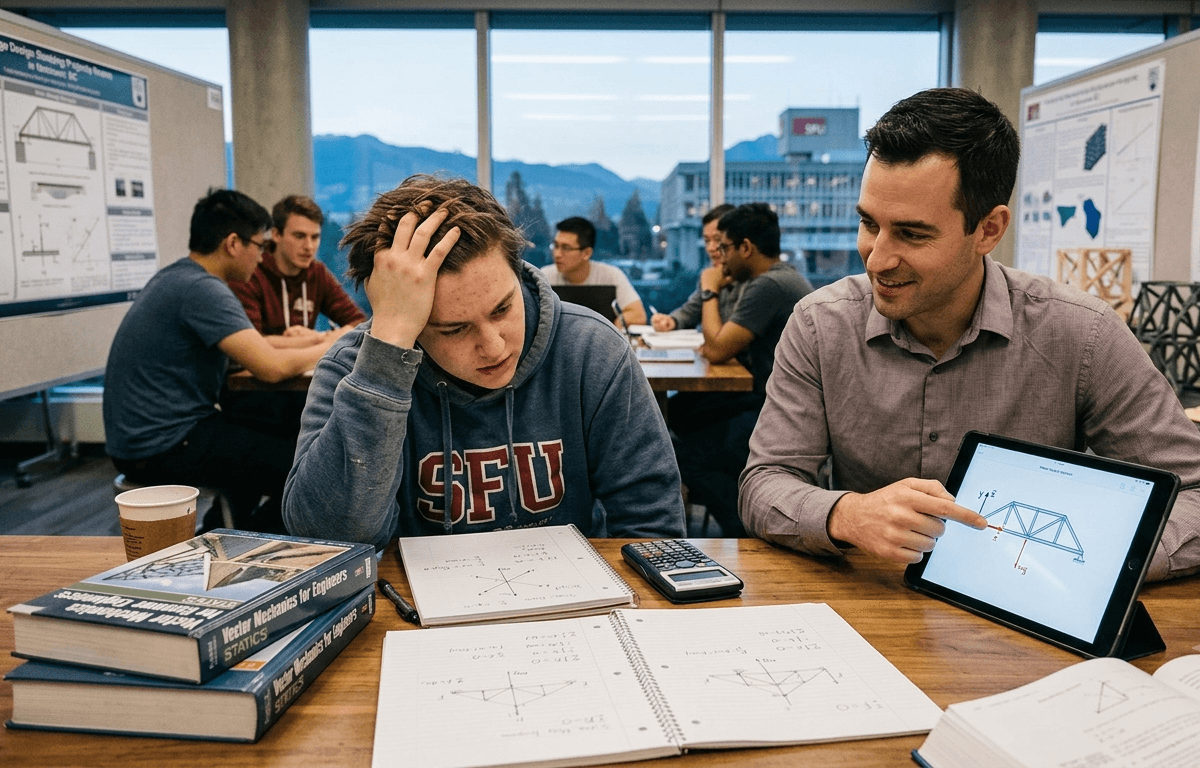
If Statics is starting to feel like it's snowballing, the earlier you address it, the easier it is to fix. A few sessions focused on free body diagrams and equilibrium equations early in the term can prevent weeks of frustration later.
Dr. Shreyank Educare offers 1-on-1 and small group tutoring in Engineering Statics, Dynamics, Mechanics of Materials and other core engineering courses for students across Burnaby, Vancouver and the surrounding Lower Mainland. Book a free consultation today to build a study plan tailored to your course and instructor.
Need one-on-one help with this? Our tutors can guide you step by step.
University Physics Tutoring